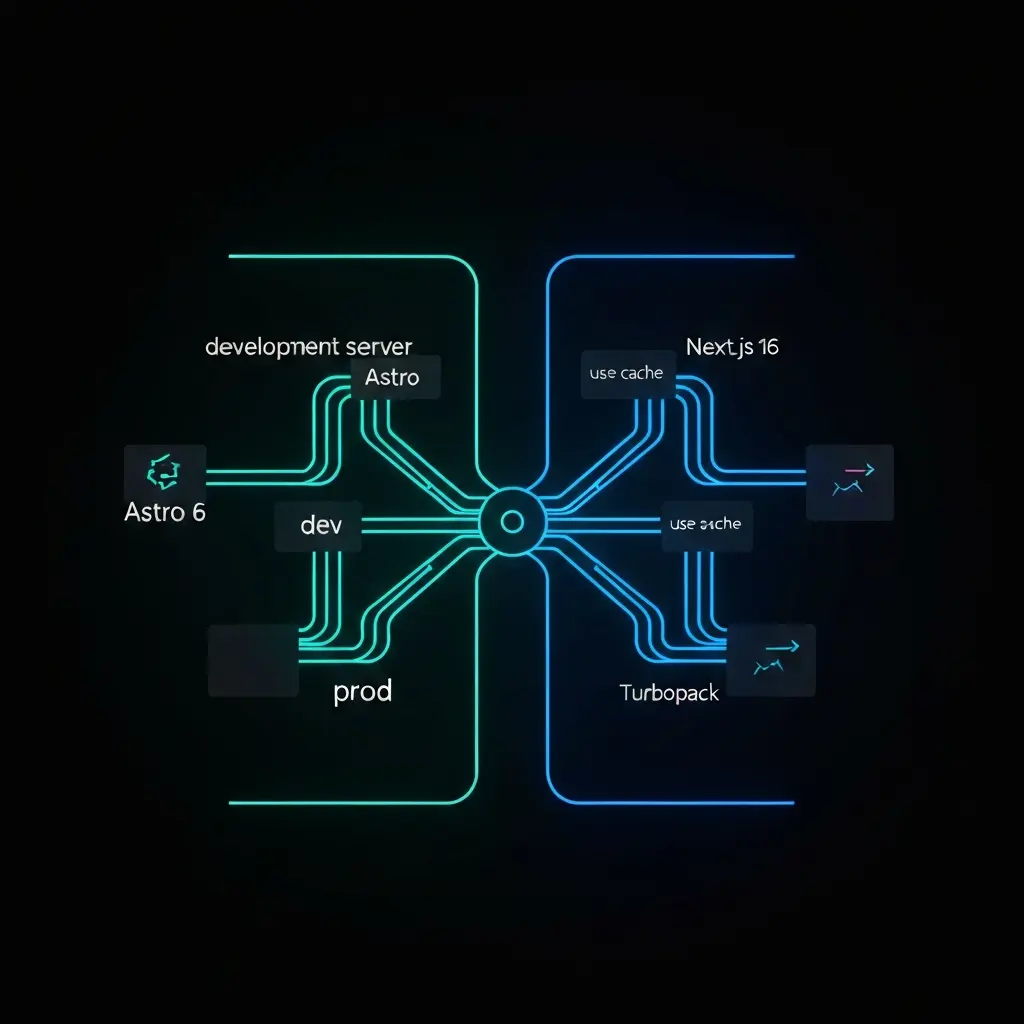
Production Parity: Deterministic Web Development in Astro, Next.js, SvelteKit
How the 2026 shift to deterministic development servers and edge runtime fidelity in Astro 6, Next.js 16, and SvelteKit is eliminating environment mismatches.
Astro 6.0 and Next.js 16 have eliminated the 'works on my machine' problem by standardising runtime fidelity—ensuring local development is bit-for-bit identical to production deployments.
Astro 6 Beta and Next.js 16 Stable deliver a major shift towards explicit data governance and absolute runtime parity, fundamentally changing how frontend teams build and deploy.
The 2026 framework releases mark a shift from performance-only optimisation to secure-by-default architectures with real-time data orchestration through stable Content Layers.
February 2026's framework updates cement a new era of runtime fidelity and component-level caching, led by Astro 6, Next.js 16.1, and SvelteKit 2.50.
The February 2026 framework updates herald a shift towards deterministic web development, prioritising production parity and reducing browser runtime bloat.
An analysis of Astro 6 Beta's Vite Environment API, which unifies dev and prod runtimes, achieves a 5x build speed boost, and signals a shift towards environment-native architecture in 2026.
February 2026's framework updates shift web architecture: SvelteKit formalises remote functions, Next.js 16 stabilises its React Compiler, and Astro 6 achieves native Cloudflare workerd integration.
We analysed the January 2026 updates to Svelte and Astro, focusing on their server-side rendering optimisations and the push towards eliminating the development-production gap.