· Web Architecture · 8 min read
Astro 6 Dev Server & Next.js 16 Caching: The 2026 Paradigm Shift
Astro 6 Beta and Next.js 16 Stable deliver a major shift towards explicit data governance and absolute runtime parity, fundamentally changing how frontend teams build and deploy.
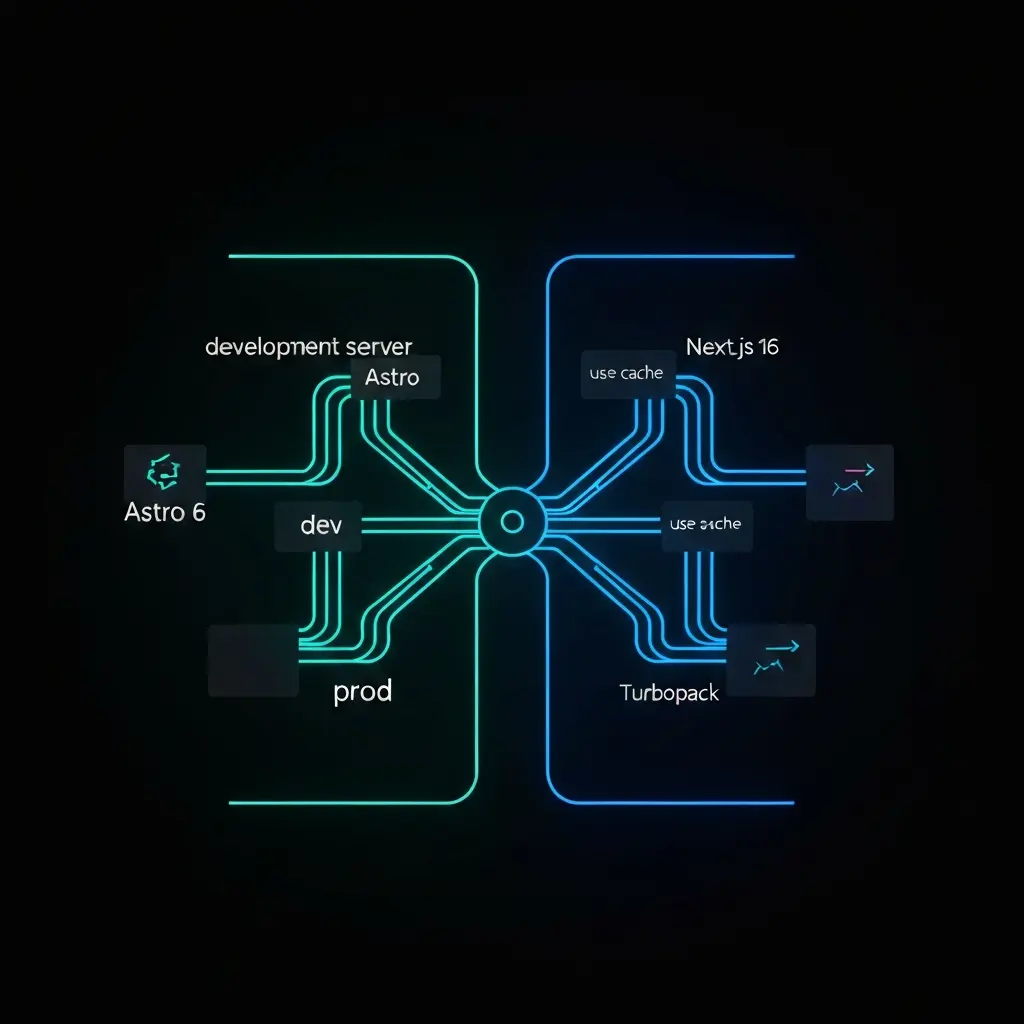
📚 Part of our 2026 Astro 6 & Next.js 16 series. For the main head-to-head comparison, see our pillar article: Next.js 16.2 vs Astro 6.1 — The 2026 Framework Speed & Precision Race.
TL;DR: February 2026 marks a decisive shift in web engineering. Astro 6 Beta achieves absolute runtime parity by rebuilding its dev server on Cloudflare’s workerd, while Next.js 16 Stable enforces explicit caching with ‘use cache’. These changes move the industry from implicit assumptions to compiler-optimised, environment-agnostic architectures.
Introduction
For years, senior engineers have navigated a treacherous gap between development and production. The local dev server, often a lightweight Node.js process, behaved fundamentally differently from the production runtime—be it a serverless function, a Cloudflare Worker, or a containerised Node instance. This divergence bred environment-specific bugs, unreliable mocks for platform-specific APIs, and a testing process that could never guarantee production fidelity. The pursuit of “it works on my machine” was a symptom of this deeper architectural flaw.
The releases of Astro 6 Beta and Next.js 16 Stable in early 2026 directly confront this core problem, but from complementary angles. The primary keyword, Runtime Parity, is no longer an aspirational goal but a technical mandate. Astro’s approach is to unify the runtime environment itself, obliterating the distinction. Next.js’s strategy is to unify data behaviour through explicit, compiler-enforced directives, removing the framework’s opaque magic. Together, they signal the end of an era defined by hidden assumptions and the beginning of one built on explicit, optimised contracts between developer and compiler.
What is Runtime Parity?
Runtime Parity is the architectural principle that a web application’s execution environment during local development must be functionally identical to its production environment. This extends beyond matching Node.js versions to encompass the specific APIs, globals, lifecycle hooks, and edge-case behaviours of the production platform’s JavaScript runtime. True parity eliminates a major category of deployment failures and ensures that performance characteristics, security policies, and data-fetching logic validated locally will hold in production. Achieving it has historically required complex Docker configurations or platform-specific tooling, but 2026’s frameworks are baking it into the core developer experience.
The End of the ‘Dev/Prod Split’: Astro 6’s Rebuilt Server
Astro 6’s most significant change is a ground-up rebuild of its development server, a direct result of its Cloudflare stewardship. Previously, the Astro dev server ran on a standard Vite/Node.js stack, while production builds could target Cloudflare’s workerd, Node.js, or other adapters. This created the classic parity gap. The new server leverages Vite’s Environment API to seamlessly swap the underlying runtime to workerd—Cloudflare’s open-source, standards-based runtime that also powers production Workers.
This technical shift has profound practical implications. Developers can now access Cloudflare’s suite of storage and state primitives—Durable Objects, KV, D1, and R2—directly from their local machine without any mocking libraries or external services. A data layer defined with astro:db interacts with the same underlying engine in both contexts. Furthermore, the stabilisation of Live Content Collections (LCC) transforms Astro’s content layer from a purely static, build-time system into a dynamic runtime capability. Content can be fetched and validated on-demand, enabling entirely new patterns for admin interfaces or frequently updated content without sacrificing type safety.
Pro Tip: When migrating to Astro 6, your
astro.config.mjswill need to reference the new@astrojs/cloudflareadapter withruntime: 'workerd'. Begin by auditing any environment-specific conditionals (if (import.meta.env.PROD)) in your codebase, as many may now be redundant.
// astro.config.mjs - Configuring for true runtime parity
import { defineConfig } from 'astro/config';
import cloudflare from '@astrojs/cloudflare';

export default defineConfig({
  adapter: cloudflare({
    runtime: 'workerd', // The key to local/production parity
    platformProxy: {
      persistTo: './.wrangler/state', // For persistent local data
    },
  }),
  // First-class CSP configuration
  security: {
    csp: {
      directives: {
        'default-src': ["'self'"],
      },
    },
  },
});
From Implicit to Explicit: Next.js 16’s Data Governance Revolution
If Astro solves parity by unifying the where, Next.js 16 addresses it by clarifying the how—specifically, how data is cached and revalidated. The framework’s previous caching model, while powerful, was often described as a “black box.” Developers relied on heuristic-based revalidation (stale-while-revalidate) and opaque deduplication, which could lead to unpredictable behaviour and difficult-to-debug staleness issues, especially in complex enterprise applications. Next.js 16’s introduction of the 'use cache' directive and the stabilisation of Turbopack as the default bundler mark a philosophical pivot to explicit control.
The 'use cache' directive allows developers to declaratively cache the results of async functions, including Server Actions and data fetchers. This shifts the model from automatic and inferred to intentional and auditable. When combined with Turbopack’s deep integration into the framework—delivering 10x faster Fast Refresh—the entire development loop becomes both faster and more predictable. The compiler now has explicit signals to optimise data flow, leading to more efficient production bundles and eliminating a class of runtime data-fetching bugs that stemmed from incorrect cache assumptions.
Pro Tip: Audit your data-fetching functions. Any
fetchcall or Server Action that benefits from persistence should be annotated. Start with stable, public API calls and user profile data. Remember, explicit caching also makes cache invalidation strategies a first-class design concern. Review the official Next.js Caching Docs for migration patterns.
// Next.js 16 - Explicitly caching a data-fetching function
export async function getPricingData(region) {
  'use cache'; // Explicit opt-in to caching
  // Without this directive, no caching occurs by default in Next.js 16
  const res = await fetch(`https://api.example.com/prices/${region}`);
  return res.json();
}

// Usage in a Server Component remains identical, but behaviour is now explicit
export default async function PricingPage({ params }) {
  const data = await getPricingData(params.region);
  // ...
}
Why Does the Tooling Ecosystem Matter?
The changes in SvelteKit 2.50 and the broader tooling landscape are not isolated improvements; they are responses to the same drive for explicitness and control that defines the major framework releases. Svelte 5.49’s export of parseCss from its compiler provides a lightweight, official CSS AST parser. This enables advanced, programmatic styling systems and tighter integration with design tooling, moving styling from a purely declarative domain to one that can be orchestrated with code—a boon for large-scale design systems.
Similarly, SvelteKit’s removal of buttonProps in favour of a new .as() syntax for form actions clarifies intent when handling multiple submit buttons. This reflects a broader trend: frameworks are providing sharper, more compositional primitives while removing ambiguous or magical abstractions. Even the migration pain point in Astro 6—the major upgrade to Zod 4 for its content schema engine—serves this goal. Zod 4’s improvements in performance and type inference result in more robust and faster content validation, reinforcing the type-safe data layer that tools like Live Content Collections depend upon.
The 2026 Outlook: Compilers as Co-pilots
The architectural trends of February 2026 point towards a future where the compiler and runtime are active, intelligent partners in the development process, not just passive tools. Next.js 16.2’s canary feature to auto-generate an AGENTS.md file via create-next-app is a telling precursor. This file provides standardised project context for AI-driven development assistants and IDEs, formalising the meta-knowledge about a project’s structure, conventions, and data patterns.
We predict this will evolve into a two-way dialogue. Developers will declare intent through directives like 'use cache' or CSP headers in astro.config.mjs. The compiler and runtime will then not only execute that intent but also analyse it to suggest optimisations, warn of anti-patterns, and generate adaptive infrastructure configurations. The goal is “absolute runtime parity” as a baseline, upon which is built a layer of AI-assisted optimisation and guardrailing. The framework is becoming the system architect’s most trusted lieutenant, enforcing rigour and enabling faster, safer iteration.
Key Takeaways
- Demand Runtime Parity: Evaluate new projects on their ability to provide a 1:1 local development environment, using platforms like Astro 6’s
workerdintegration as the new standard. - Adopt Explicit Caching: Begin refactoring data-fetching logic in Next.js applications to use the
'use cache'directive, transforming caching from a hidden behaviour to a designed contract. - Treat Content as Dynamic: Leverage Astro’s Live Content Collections to build hybrid applications where content is type-safe but can be updated without a full rebuild.
- Plan for Zod 4 Migration: If using Astro Content Collections, allocate time for the breaking changes and schema updates required by the Zod 4 upgrade to maintain validation.
- Embrace Declarative Security: Utilise the native CSP configuration in Astro 6 to define content security policies as code, moving security left in the development lifecycle.
Conclusion
The releases of Astro 6 and Next.js 16 represent a convergent evolution in web engineering. Both are responses to the growing complexity and scale of modern applications, solving the problem by moving from implicit, environment-dependent behaviours to explicit, compiler-optimised declarations. Whether through unifying the runtime substrate or clarifying data flow, the result is the same: fewer environment-specific bugs, more predictable performance, and architectures that are inherently more portable and resilient. This shift towards explicitness and parity is not merely a feature update; it is a foundational change in how we conceive the boundary between development and deployment. At Zorinto, we help engineering leaders navigate these foundational shifts, implementing robust architectures that leverage these new paradigms for scalable, maintainable advantage.