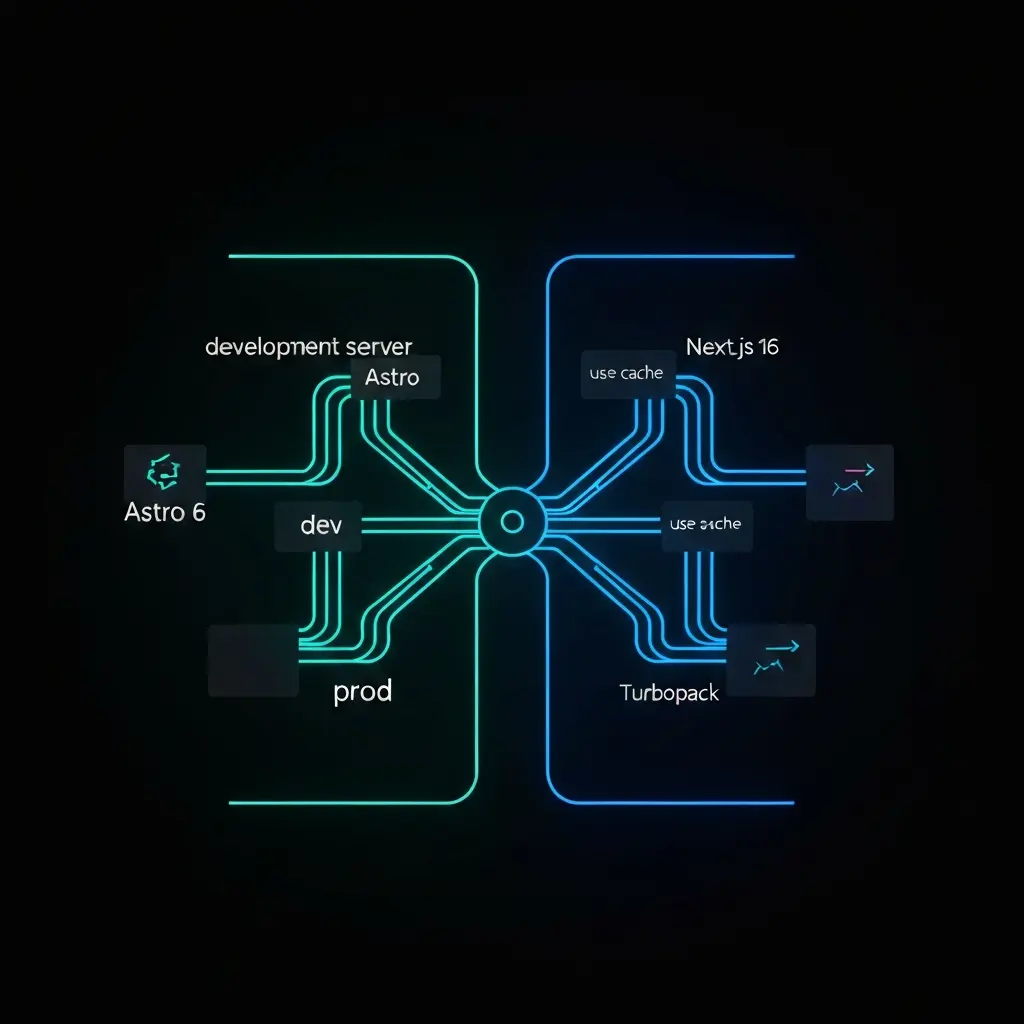
Astro 6 Dev Server & Next.js 16 Caching: The 2026 Paradigm Shift
Astro 6 Beta and Next.js 16 Stable deliver a major shift towards explicit data governance and absolute runtime parity, fundamentally changing how frontend teams build and deploy.
The 2026 framework releases mark a shift from performance-only optimisation to secure-by-default architectures with real-time data orchestration through stable Content Layers.
February 2026's framework updates cement a new era of runtime fidelity and component-level caching, led by Astro 6, Next.js 16.1, and SvelteKit 2.50.
The February 2026 framework updates herald a shift towards deterministic web development, prioritising production parity and reducing browser runtime bloat.
An analysis of Astro 6 Beta's Vite Environment API, which unifies dev and prod runtimes, achieves a 5x build speed boost, and signals a shift towards environment-native architecture in 2026.
February 2026's framework updates shift web architecture: SvelteKit formalises remote functions, Next.js 16 stabilises its React Compiler, and Astro 6 achieves native Cloudflare workerd integration.
Astro 6 Beta, Next.js 16, and SvelteKit's latest updates are converging on a new standard: local development that perfectly mirrors edge production, eliminating deployment surprises.
Astro 6 Beta and Next.js 16 are eliminating 'works on my machine' by aligning local development with production runtimes like Cloudflare's workerd and Node.js, creating true environment-native development.
January 2026's Cloudflare acquisition and framework updates signal a decisive architectural divergence toward edge-native security, runtime parity, and enhanced performance.