· Web Architecture · 8 min read
AWS 2026 Infrastructure Refresh: Native S3 Access & Xeon 6 RDS
Amazon’s 2026 platform updates enable POSIX-compliant S3 Files for high-throughput shared access and custom Intel Xeon 6 RDS instances for superior database performance.
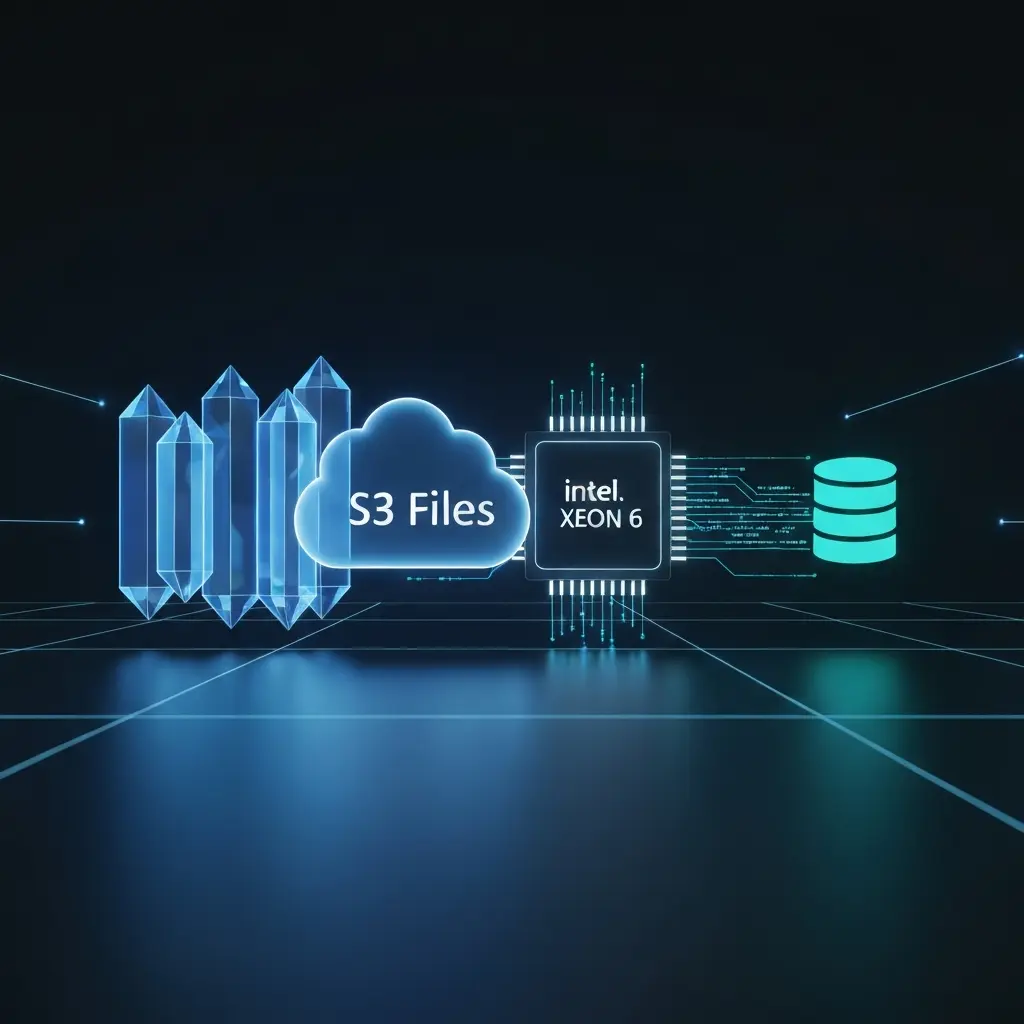
TL;DR: The core AWS 2026 infrastructure refresh delivers two pivotal shifts: a native POSIX-compliant file system interface for Amazon S3 (S3 Files) enabling high-throughput shared access, and 8th generation RDS instances powered by custom Intel Xeon 6 processors, offering a 15% price-performance leap for database workloads.
For years, enterprise architects have wrestled with a fundamental cloud storage dichotomy. Applications built for traditional file systems could not directly leverage the limitless scale and durability of Amazon S3 without costly data duplication or complex gateway appliances. Simultaneously, database performance has been bottlenecked by the limitations of general-purpose cloud hardware, forcing trade-offs between cost, memory bandwidth, and computational efficiency. This April 2026, AWS has directly addressed these architectural tensions with its latest platform updates, moving beyond incremental improvements to redefine core infrastructure paradigms. The general availability of Amazon S3 Files and the launch of custom Intel Xeon 6-powered M8i/R8i instances for Amazon RDS represent a concerted push towards higher-fidelity, higher-performance primitives. This AWS 2026 infrastructure evolution signals a move from adapting to native integration, promising to simplify data lakes and accelerate transactional systems alike.
What is the AWS 2026 Infrastructure Refresh?
The AWS 2026 infrastructure refresh is a series of strategic platform updates that introduce new, deeply integrated service capabilities and custom hardware, moving beyond off-the-shelf components. Its hallmark is the unification of previously disparate operational models, most notably bringing native POSIX-compliant file access to object storage with S3 Files, and deploying bespoke Intel Xeon 6 (Granite Rapids) processors exclusively within the AWS Nitro System to power the latest generation of database-optimised RDS instances. This refresh is not merely about faster CPUs or new features; it is an architectural commitment to reducing friction and increasing performance for foundational workloads like data analytics and online transaction processing.
Unifying File and Object Models: The S3 Files Architecture
The launch of Amazon S3 Files resolves a longstanding impedance mismatch. By providing a fully POSIX-compliant file system interface, it allows applications that expect standard file operations (open, read, write, seek) to interact directly with an S3 bucket. The technical mechanism is not a gateway but a native, distributed file system built on S3’s object foundation. It maintains S3’s durability and scalability while adding file system semantics like strong consistency, atomic renames, and directory hierarchies.
Crucially, the architecture supports an aggregate read throughput of multiple terabytes per second. This is achieved by distributing metadata and data access across a scalable control plane and leveraging S3’s existing massive parallel throughput. Thousands of EC2, ECS, or EKS instances can now mount the same S3 Files system concurrently for high-performance shared access, eliminating the need to copy data into ephemeral block storage for processing.
# Example: Mounting an S3 Files system on an Amazon Linux 2023 instance
# The file system is accessed via a standard mount command.
sudo mount -t s3files \\
  my-s3files-mountpoint \\
  -o bucket=my-data-lake-bucket,region=eu-west-2

# Applications can then use standard I/O libraries.
import pandas as pd
# Read a Parquet file directly from the mounted S3 Files system
df = pd.read_parquet('/my-s3files-mountpoint/analytics/dataset.parquet')
Pro Tip: For maximum throughput, ensure your client instances (e.g., compute-optimised C7i instances) are in the same AWS Region and Availability Zone as your S3 Files bucket. This minimises latency and leverages the full bandwidth of the AWS backbone network.
The business value is profound: it renders legacy data synchronisation and ETL pipelines for file-based tools obsolete. Data engineering teams can now build pipelines where data lands once in S3 and is immediately accessible to BI tools, legacy applications, and high-performance computing clusters without movement or transformation. For a detailed look at POSIX compliance and performance benchmarks, consult the Amazon S3 Files User Guide. This capability dovetails with other 2026 updates, such as IPv6 support in the AWS Transfer Family, facilitating seamless, modern data ingestion.
Database Evolution: The Custom Silicon of RDS M8i and R8i
If S3 Files addresses data access, the new 8th generation M8i and R8i instances for Amazon RDS target data processing at its core. These instances are powered by custom-designed Intel Xeon 6 processors, codenamed Granite Rapids, which are exclusive to AWS in this hardware cycle. This customisation, deeply integrated with the Nitro System, allows AWS to optimise specifically for database workloads, moving beyond the one-size-fits-all approach of commodity hardware.
The reported 15% price-performance improvement over the 7th generation (M7i/R8i) stems from architectural enhancements beyond just clock speed. The R8i instances, designed for memory-intensive workloads, benefit from a 2.5x increase in memory bandwidth compared to their Intel-based predecessors. This directly accelerates operations like large in-memory joins, sorting, and caching, reducing query latency for analytical workloads on OLTP systems. The M8i instances leverage core and cache optimisations for high-transaction-rate processing.
-- Database performance gains are most visible in memory-bound operations.
-- Example: A complex analytical query on R8i benefits from higher bandwidth.
EXPLAIN ANALYZE
SELECT customer_id, SUM(order_value), AVG(order_value)
FROM orders
WHERE order_date > '2025-01-01'
GROUP BY customer_id
HAVING COUNT(*) > 10
ORDER BY SUM(order_value) DESC;
-- The speed of sorting (ORDER BY) and aggregation (GROUP BY, SUM, AVG)
-- is significantly enhanced by the increased memory bandwidth.
Pro Tip: When upgrading from M7i/R7i to M8i/R8i families, conduct performance validation under peak load. The 15% average gain can be higher for memory-bandwidth-sensitive queries. Monitor the
ReadIOPS,WriteIOPS, andDatabaseConnectionsCloudWatch metrics before and after migration to quantify the improvement.
This hardware advancement is complemented by software updates like cross-account snapshot sharing for RDS Oracle with scaled storage (up to 256 TiB), which enhances disaster recovery and development workflow flexibility. The underlying trend is clear: AWS is vertically integrating its database stack, from custom silicon to managed service features, to deliver deterministic performance gains.
Why Do the Broader 2026 Updates Matter for Architects?
The S3 Files and RDS silicon launches are the headliners, but the surrounding April 2026 updates form a cohesive narrative of maturation and operational refinement. The integration of natural language querying (NLQ) into AWS Cost Explorer via Amazon Q is a prime example. It transforms cost management from a manual, filtering-heavy audit into a conversational investigation, enabling sub-second attribution of complex cost spikes.
Similarly, the general availability of PostgreSQL 18.3 and 17.9 on RDS, with support for the Amazon Organisations Upgrade Rollout Policy, underscores a focus on security and governance at scale. The 108-qubit Rigetti ‘Cepheus’ QPU on Amazon Braket, with its improved CZ gates, represents a longer-term strategic bet on reducing quantum noise—a foundational requirement for future-proofing certain algorithmic workloads. Each update, from IPv6 support for secure file transfer to advanced quantum error reduction, incrementally removes friction, enhances security, or opens new computational frontiers, allowing senior engineers to focus on innovation rather than infrastructure mechanics.
The 2026 Outlook: Architectural Predictions
Based on this refresh, we can forecast specific architectural shifts over the coming year. The adoption of S3 Files will rapidly accelerate the consolidation of data lakes and lakehouses, as the technical barrier to using a single storage tier for both object and file workloads disappears. We will see a rise in ‘direct-query’ architectures where analytical engines query data in place via S3 Files, minimising data movement. For databases, the success of custom Xeon 6 silicon will likely spur AWS to develop more workload-specific processors, perhaps for graph databases or real-time analytics engines. Furthermore, the demonstrated value of NLQ in Cost Explorer will catalyse its integration into other operational consoles, making AI-assisted operations the default for cloud management. The overarching theme will be integration over interfacing, as AWS continues to build deeper, more efficient pathways between its core services.
Key Takeaways
- Eliminate Data Silos with S3 Files: You can now retire complex file gateway solutions and data duplication pipelines. Legacy file-based applications can access S3 directly using POSIX semantics, simplifying your data lake architecture.
- Target Memory-Intensive Workloads with R8i: For databases hampered by memory bandwidth constraints (e.g., large reporting queries on transactional systems), the R8i instances offer a significant 2.5x bandwidth uplift, which can dramatically reduce latency.
- Validate the 15% Performance Claim: The price-performance gain of M8i/R8i over the previous generation is an average. Profile your specific database workload to identify queries that will benefit most from the new custom silicon.
- Operationalise Cost Intelligence: Integrate Amazon Q’s natural language queries in Cost Explorer into your FinOps routines to move from monthly reporting to real-time, actionable cost intelligence.
- Plan for Native IPv6: With AWS Transfer Family now supporting IPv6 natively, begin updating security group and network ACL policies to facilitate secure, protocol-native communication with global partners.
Conclusion
The April 2026 AWS updates represent a substantive leap in cloud infrastructure design, moving from providing raw components to delivering solved, high-performance primitives. The introduction of S3 Files finally reconciles the file-object divide, while the custom Intel Xeon 6 processors in RDS instances demonstrate a clear path beyond commodity cloud hardware. For technical leaders, this refresh reduces architectural compromise, allowing systems to be both simpler and more powerful. Navigating these new capabilities and integrating them into existing estates requires precise planning and validation. At Zorinto, our cloud architects work closely with engineering teams to leverage these foundational updates, designing and implementing optimised data and database architectures that fully capitalise on the evolving AWS platform.