· Web Architecture · 7 min read
GPT-5.5 'Think Deeper' and Local-First AI Architectures in 2026
The enterprise AI stack has pivoted. This deep dive analyses the post-May 2026 shift to dual-tier reasoning and local-first processing, driven by the GPT-5.5 'Think Deeper' model and critical governance controls.
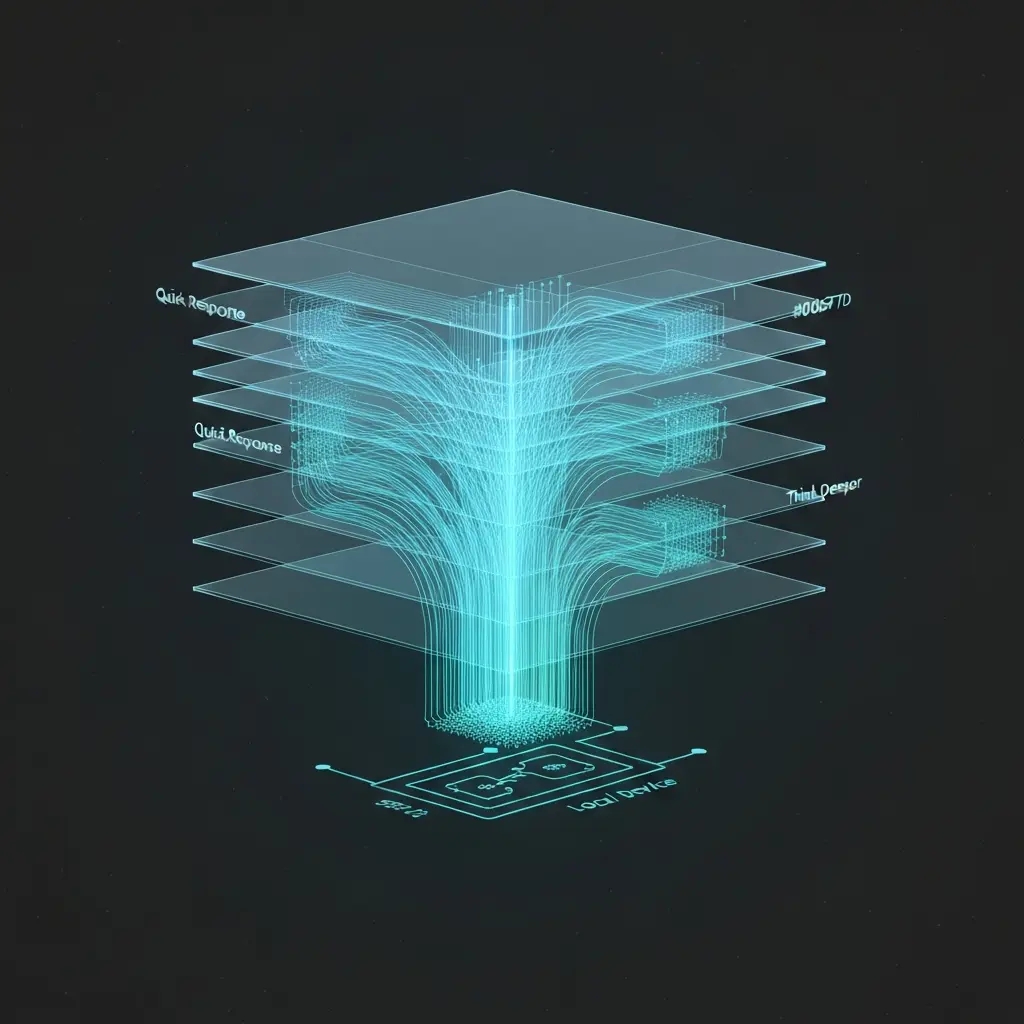
TL;DR: The May 2026 AI landscape has bifurcated. Enterprise stacks now adopt dual-tier reasoning, pairing low-latency response with the GPT-5.5 ‘Think Deeper’ tier for complex logic. This evolution is fundamentally anchored by a new local-first processing model for data sovereignty, with stringent governance controls like Microsoft’s EU Flex Routing and Google’s AI Control Center becoming mandatory architecture components.\n\n## Introduction: From Chat Interfaces to Architectural Tiers\n\nUntil recently, enterprise AI was largely a question of interface design—how best to wrap a cloud-based language model in a chat window. The release of GPT-5.5 Instant in mid-May 2026, and its immediate integration into Microsoft 365 Copilot, marks a definitive end to that era. The architectural problem has shifted from access to orchestration: how to intelligently route between low-latency tasks and high-reasoning, multi-step workflows while maintaining ironclad data sovereignty. This is no longer about a single model call; it is about designing systems that understand when to think fast and when to think deeper. The concurrent maturation of the Model Context Protocol (MCP) and a suite of granular governance tools signifies this transition from a feature-centric to an infrastructure-centric paradigm for artificial intelligence. The GPT-5.5 Instant model is the catalyst, but the real story is the architectural framework it necessitates.\n\n## What is the Reasoning Tier?\n\nIn the context of the 2026 enterprise AI stack, the ‘Reasoning Tier’ is an architectural pattern that segregates artificial intelligence workloads based on computational and logical complexity. It moves beyond a one-size-fits-all model invocation. Instead, it implements an intelligent routing layer—like Microsoft’s dual-tier ‘model picker’—which directs simple, retrieval-based queries to a low-latency ‘Quick Response’ path. Concurrently, it reserves intricate tasks requiring chain-of-thought, multi-step analysis, or agentic planning for a dedicated high-reasoning engine, exemplified by the GPT-5.5 Instant model’s ‘Think Deeper’ mode. This tier is characterised not just by model capability but by its integration with local-first data processing and rigorous governance protocols to ensure compliance and control.\n\n### The Dual-Tier Model Picker: Architecting for Intent\n\nThe technical pivot is most visible in Microsoft 365 Copilot’s new model selection logic. It is no longer a monolithic call to an API endpoint; it is a decision engine. The ‘Quick Response’ tier likely leverages heavily cached, distilled models or highly optimised inference paths for tasks like summarisation or simple Q&A. The ‘Think Deeper’ tier, invoking the full reasoning capacity of GPT-5.5 Instant, is reserved for scenarios such as generating a multi-step data analysis plan in Excel’s new ‘Plan Mode’ or constructing a complex chain of edits. The business value is twofold: cost optimisation (not paying for ‘reasoning’ on every prompt) and user experience clarity, as seen when Excel previews a step-by-step execution roadmap before applying changes.\n\n> Pro Tip: When designing prompts for a dual-tier system, explicitly signal complexity. For a ‘Think Deeper’ task, structure your prompt with clear step delineations (e.g., “First, analyse the variance between Q1 and Q2 sales. Second, correlate this with regional marketing spend. Third, propose three mitigating actions.”) to guide the chain-of-thought reasoning.\n\n### Local-First AI: Sovereignty as a Core Primitive\n\nThe most significant 2026 architectural shift is the move of AI processing to the data’s locus, breaking the cloud-dependency chain. Microsoft’s enabling of multi-step Copilot edits on locally stored Excel workbooks is a landmark. The AI model’s reasoning operates on a secure, ephemeral context within the device’s memory, with edits committed directly to the local file—bypassing OneDrive sync entirely. This aligns with Google’s General Availability of bulk import with Client-Side Encryption (CSE), ensuring keys never leave enterprise control. The mechanism here is a trusted execution environment on the endpoint, managed by the Office or Workspace client, which acts as a secure conduit for the model’s instructions.\n\n
python\n# Pseudocode illustrating a local-first AI edit flow\ndef execute_local_ai_edit(workbook_path, ai_instruction):\n # 1. Securely load workbook into isolated, local sandbox\n local_workbook_context = load_to_secure_sandbox(workbook_path)\n \n # 2. Generate edit plan via 'Think Deeper' tier (plan metadata only)\n edit_plan = ai_orchestrator.request_plan(ai_instruction, tier="deep")\n \n # 3. Present plan to user for validation via UI ('Plan Mode')\n if user_approves(edit_plan):\n # 4. Execute approved plan directly on local sandbox\n apply_plan_to_sandbox(local_workbook_context, edit_plan)\n # 5. Save result locally, no cloud dependency\n save_locally(workbook_path, local_workbook_context)\n\n\n### Why Does Agentic Access Demand a New Governance Model?\n\nThe formalisation of the Model Context Protocol (MCP) by both Microsoft and Google unlocks powerful agentic workflows, such as those built with Google Workspace Studio’s intent-based ‘Skills’. However, persistent autonomous agents accessing live data create novel risk vectors, notably indirect prompt injection. The May 2026 response is a new layer of runtime governance. Microsoft Purview now applies real-time Data Loss Prevention (DLP) to Copilot web search prompts, scanning and redacting sensitive data before it leaves the enterprise perimeter for web grounding. Google’s AI Control Center provides the complementary dashboard: a centralised interface for IT admins to audit and restrict which ‘Skills’ or agents can access specific data types (e.g., limiting a meeting recap agent to calendar data only).\n\nAccording to Google Workspace’s update blog, the AI Control Center allows administrators to “set granular access policies for AI features across organisational units, providing a clear audit trail of agentic data interactions.” This transforms governance from a static, policy-based exercise to a dynamic, runtime enforcement mechanism.\n\n> Pro Tip: Implement governance before enabling MCP connectors. Map your data taxonomy to the access levels required by different agent personas (e.g., ‘Financial Analyst Agent’ vs. ‘HR Onboarding Agent’) within tools like the AI Control Center or Microsoft Purview to prevent over-provisioning from day one.\n\n### Data Sovereignty 2026: Beyond Policy to Protocol\n\nIn 2026, data sovereignty is engineered into the protocol layer, not just the policy document. Microsoft’s ‘Flex Routing’ for EU/EFTA tenants, with its new ‘Residency Lock’ toggle, is a prime example. This technical control prevents the system’s load-balancing logic from overflowing LLM inference requests to non-EU data centres during peak loads—a scenario where a mere policy would be ineffective. Similarly, Google Meet’s requirement for explicit participant consent before AI-generated notes or recaps is a protocol-level enforcement of privacy-by-design. These are not configuration options; they are architectural guarantees that ensure compliance is maintained even under system duress or user error.\n\n## The 2026 Outlook: The Integrated Reasoning Fabric\n\nLooking forward, the trajectory points towards an ‘Integrated Reasoning Fabric’. We predict the duality of ‘Quick’ and ‘Deep’ tiers will evolve into a more fluid, continuous spectrum of reasoning cost and capability, managed dynamically by the orchestrator. The Model Context Protocol will become the universal bus for agentic workflows, with standardised connectors for all major enterprise data planes. Crucially, local-first processing will expand beyond office suites into developer environments and line-of-business applications, with secure enclaves on employee devices becoming a standardised compute node in the distributed enterprise AI stack. Governance will become fully declarative and codified as infrastructure-as-code, allowing compliance rules to be version-controlled and deployed alongside the AI agents they regulate.\n\n## Key Takeaways\n\n- Enterprise AI architecture must now explicitly design for a dual-tier reasoning model, routing tasks between low-latency and high-complexity pathways.\n- Local-first AI processing is the cornerstone of 2026 data sovereignty, requiring a re-architecture of how models interface with sensitive, regulated data.\n- The Model Context Protocol (MCP) is the emerging standard for agentic data access; its adoption necessitates equally mature runtime governance tools like Google’s AI Control Center.\n- Compliance features like Microsoft’s EU ‘Residency Lock’ are shifting from administrative toggles to non-bypassable architectural protocols.\n- User consent and transparency, as seen in Google Meet’s explicit permissions, are becoming hard technical requirements, baked into the UI and data flow.\n\n## Conclusion\n\nThe post-May 2026 landscape represents a maturation of enterprise artificial intelligence from a novel capability to a core, governed infrastructure component. The introduction of reasoning tiers like GPT-5.5 Instant’s ‘Think Deeper’ mode solves for intelligence, while the pivot to local-first processing and protocol-level sovereignty controls solve for trust. The future stack is heterogeneous, distributed, and intelligently orchestrated. At Zorinto, we help clients navigate this complexity by architecting and implementing these next-generation, sovereign AI systems, ensuring they achieve both transformative capability and unimpeachable compliance.